
Arsenal News
“THE SHAME OF SPANISH FOOTBALL,” Jarell Quansah directly insulted Noni Madueke after the latter accused him of diving to win a penalty for Arsenal. In addition, Quansah also advised the Arsenal players to switch to women’s football…

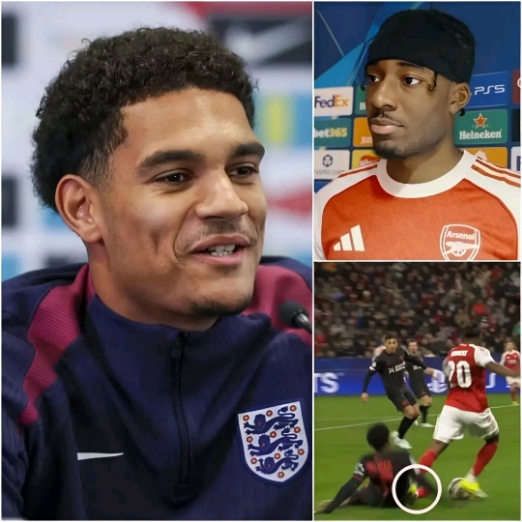
“THE SHAME OF SPANISH FOOTBALL,” Jarell Quansah openly insulted Noni Madueke after the latter claimed he had dived to earn a penalty for Arsenal. Furthermore, Quansah suggested that the Arsenal players should consider transitioning to women’s football.
In a swift reaction, Noni Madueke shared a brief message on social media consisting of just 10 words, which was sufficient to mock Jarell Quansah publicly.
This incident arose from a contentious late penalty awarded to Arsenal in the 89th minute. Substitute Noni Madueke, who replaced Bukayo Saka as Arsenal sought an equalizer, penetrated the box and fell after minimal contact from Leverkusen defender Malik Tillman. Replays indicated a soft yet arguably valid foul, as Tillman’s challenge made contact with Madueke’s ankle during a tricky run. VAR confirmed the decision without necessitating a pitch-side review, enabling Kai Havertz—returning to his former club—to calmly convert the penalty and secure a crucial away draw for the Gunners.
After the match, tensions escalated. Jarell Quansah, who had previously tested Arsenal’s defense with a powerful shot blocked by Gabriel (which required treatment after hitting him on the chin), took to social media to express his frustration. In a now-deleted or heated post that circulated widely, Quansah directly accused Madueke of simulation, branding the incident as obvious diving to win a penalty. He further escalated the situation by sarcastically suggesting that Arsenal players should “switch to women’s football” if they planned to keep using such tactics—a comment many perceived as a misogynistic jab implying a lack of toughness or exaggeration in winning decisions.
The comment sparked immediate backlash. Critics labeled it not only unprofessional but also indicative of deeper issues within the men’s game, where casual sexism tends to emerge under pressure. Quansah’s outburst faced condemnation from fans, pundits, and even some members of the women’s football community, who pointed out the irony of using the women’s game as a derogatory reference while the women’s Euros and domestic leagues continue to gain popularity and skill.
Noni Madueke, who is no stranger to controversy in his career path from Chelsea to Arsenal, reacted quickly on social media. In a brief post of just 10 words—”Keep crying while we collect points and trophies, mate”—he provided a sharp, composed response that ridiculed Quansah’s frustration without resorting to personal attacks. The message went viral within minutes, receiving thousands of likes, retweets, and quotes from supporters who praised its restraint and effectiveness. It shifted the narrative back onto Quansah, depicting the Liverpool academy product as bitter in defeat rather than principled in his critique.
This exchange has intensified existing rivalries. Madueke’s transfer to Arsenal in recent windows has been a contentious issue, particularly given his history with Chelsea and his rise as a key player under Mikel Arteta. Quansah, on the other hand, has worked to restore his reputation abroad after departing Anfield, making solid contributions in defense for Leverkusen during their post-Xabi Alonso phase. The two England internationals—both part of recent Three Lions squads under Thomas Tuchel—now find themselves in conflict, underscoring how club loyalties can overshadow national unity.
The penalty itself sparked a divided opinion. Arsenal supporters highlighted the contact and the way Madueke’s momentum was interrupted, arguing that it fulfilled the criteria for a penalty kick according to contemporary interpretations. Conversely, Leverkusen fans and neutral observers criticized it as yet another instance of larger clubs gaining from questionable decisions in Europe, with some reiterating Quansah’s accusation of diving. The Bayer manager expressed his disappointment after the match, stating: “For me it’s not a penalty,” while recognizing the narrow margins that define the game. On the other hand, Arteta defended his team’s determination, pointing out the effect of the substitution and Havertz’s calmness.
Beyond the match, this incident raises concerns regarding the conduct of high-profile players on social media. Quansah’s comment ventured into a realm that could attract scrutiny from the FA or UEFA, particularly due to the gendered nature of the insult. Previous similar occurrences have resulted in fines or warnings, although the enforcement of such measures has been inconsistent. Madueke’s response, while sharp, remained within the limits of friendly banter, earning him praise for his composure under provocation.
English football has historically struggled with the issues of diving and gamesmanship, from long-standing discussions about players like Luis Suárez to more recent controversies surrounding VAR. This latest incident—featuring two emerging talents—serves as a reminder that emotions can run high when the stakes are elevated in the Champions League. With the second leg approaching at the Emirates, the matchup remains delicately poised, but the verbal exchanges may resonate longer than the tactical evaluations.
As Arsenal moves closer to another quarter-final opportunity and Leverkusen aims for redemption at home, attention will return to the field. However, for the moment, the spotlight is on Quansah’s outburst and Madueke’s concise rebuttal—a quintessential example of impulsive passion colliding with measured response in today’s game.
The exchange highlights a larger reality: in a time of immediate responses and worldwide observation, words can hurt just as profoundly as failed tackles. Whether this influences future selections for England or merely intensifies club rivalries is yet to be determined. One thing is clear—neither player will soon forget this meeting.


-
 Arsenal News1 year ago
THE LATEST CONFIRMED TRANSFER NEWS AHEAD OF SUMMER TRANSFER WINDOW 2025: LIVERPOOL HAVE FINALIZED THEIR FIRST SUMMER TRANSFER BY AGREEING TO SIGN ✅ – RODRYGO HAS CHOSEN BETWEEN LIVERPOOL AND ARSENAL ✅ – VIKTORGYOKERES TO ARSENAL ✅
-

 Arsenal News1 year ago
THE LATEST CONFIRMED TRANSFER NEWS AHEAD OF SUMMER TRANSFER WINDOW 2025: MILOS KERKEZ “AGREEMENT DONE” WITH LIVERPOOL ✅ – ARSENAL AGREE GYOKERES DEAL ✅ – MANCHESTER UNITED HAVE COMPLETED THE SIGNING OF MATHEUS CUNHA FROM WOLVES…
-
 Arsenal News1 year ago
THE LATEST CONFIRMED TRANSFER NEWS AHEAD OF SUMMER TRANSFER WINDOW 2025. ZUBIMENDI TO ARSENAL ✅ – Kevin De BRUYNE TO LIVERPOOL ✅ AND TRANT ALEXANDER-ARNOLD UPDATE…
-

 Arsenal News1 year ago
THE LATEST CONFIRMED TRANSFER NEWS AHEAD OF SUMMER TRANSFER WINDOW 2025: LIVERPOOL HAVE FINALIZED THEIR FIRST SUMMER TRANSFER BY AGREEING TO SIGN ✅ – VIKTOR GYOKERES TO ARSENAL ✅ – JEREMIE FRIMPONG TO LIVERPOOL ✅ – RODRYGO UPDATES…
-
 Arsenal News1 year ago
THE LATEST CONFIRMED TRANSFER NEWS AHEAD OF SUMMER TRANSFER WINDOW 2025: LIVERPOOL SET TO FINALIZED THE SECOND SUMMER TRANSFER ✅ – ARSENAL AGREE GYOKERES DEAL ✅ – MANCHESTER UNITED SET TO SIGN £2.5M CUNHA ✅ – KLOPP SET FOR SENSATIONAL RETURN TO MANAGEMENT…
-
 Liverpool News2 years ago
Real Madrid have signed Trent Alexander-Arnold on a free transfer, after his contract with Liverpool came to an end, with an agreement now in place between the player and Real Madrid.
-

 Arsenal News1 year ago
THE LATEST CONFIRMED TRANSFER NEWS AHEAD OF SUMMER TRANSFER WINDOW 2025: BENJAMIN ŠEŠKO “AGREEMENT DONE” WITH ARSENAL ✅ – LIVERPOOL HAVE COMPLETED THE SIGNING OF FLORIAN WIRTZ FROM BAYER LEVERKUSEN ✅ – MANCHESTER UNITED AGREE BRYAN MBEUMO…
-
 Arsenal News1 year ago
BREAKING NEWS: Viktor Gyokeres to Arsenal summer transfer bombshell – ‘On his way’…